California Advance Health Care Directive — Notary Rules in 2026
California's Advance Health Care Directive needs either a notary OR two qualified witnesses — not both. The witness rules are stricter than people realize. Here's how the form works and how to get it signed correctly.

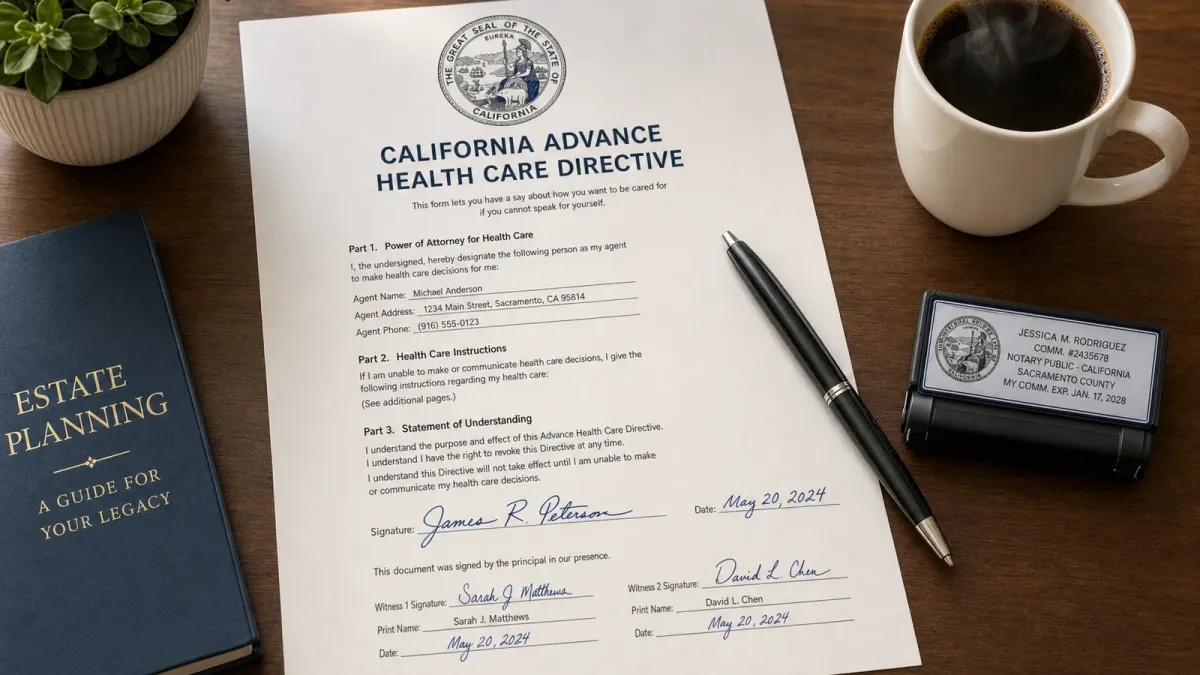
Short version: A California Advance Health Care Directive needs to be either notarized OR signed in front of two qualified witnesses — not both, but at least one. The two-witness path is free but has specific rules about who can witness (no employees of the health care provider, and at least one witness can't be related or stand to inherit). The notary path is simpler if you don't have qualified witnesses handy. If you'd rather have a mobile notary come to you and skip the witness logistics, call (213) 933‑2507.
What an Advance Health Care Directive actually does
An Advance Health Care Directive (often called an "AHCD" or sometimes a "living will" plus "healthcare power of attorney") is the document where you tell doctors and hospitals two things:
- What kind of medical treatment you do or don't want if you can't communicate — life support, resuscitation, artificial nutrition, pain management preferences, organ donation
- Who gets to make decisions for you if you can't make them yourself — your "health care agent" (also called a healthcare proxy or healthcare POA)
It only kicks in when you can't speak for yourself. As long as you're conscious and competent, you make your own decisions, regardless of what the document says. The directive is a backup, not a takeover.
California's standard form is laid out in Probate Code §4701 — it's free, it's well-designed, and most people don't need anything fancier. You can also use an attorney-drafted version if your situation is complicated.
The signing requirement: notary OR two witnesses
This is the part that trips people up. California Probate Code §4673 gives you two valid ways to execute an AHCD:
- Option 1: Sign in front of a notary public. One signature, one notary, done.
- Option 2: Sign in front of two qualified adult witnesses who both watch you sign and then sign the witness section themselves.
You only need one of these. Not both. Either path produces a legally valid AHCD in California.
Who can be a witness (the rules are stricter than you think)
If you go the two-witness route, California Probate Code §4674 sets out who qualifies. To witness an AHCD in California, the person must be an adult, and cannot be:
- The person you're naming as your health care agent
- Your health care provider, or an employee of your health care provider (this is a big one — your doctor, your nurse, your hospital's chaplain, all out)
- The operator or employee of a community care facility
- The operator or employee of a residential care facility for the elderly
And at least one of the two witnesses must not be:
- Related to you by blood, marriage, or adoption
- Entitled to any part of your estate under your will or by intestate succession
In practice, this rules out a lot of the people who'd be most convenient — your kids, your siblings, the staff at the assisted living facility where you live, your primary care doctor. That's why a lot of people end up at the notary route. The notary doesn't have the same "no relationship" restrictions.
Special rule if you're in a skilled nursing facility
If you're a patient in a skilled nursing facility when you sign your AHCD, California requires an additional witness: a patient advocate or ombudsman must also sign as a witness, regardless of whether you use notarization or the two-witness route. This rule exists to protect patients from being pressured into directives that don't reflect their actual wishes.
Need an AHCD notarized at home, a hospital, or a nursing facility? Call (213) 933‑2507. We're mobile across LA and we know the rules.
Naming your health care agent — the most important decision
The form takes 15 minutes to fill out. The decisions take longer. The single most important choice is who you name as your health care agent.
Things to think about:
- Will they actually be reachable? The person across the country who never picks up may not be the right call.
- Will they advocate for you? Hospitals can be pushy. Your agent needs to be willing to ask hard questions and push back.
- Will they follow your wishes even if they disagree? This one is hard. A spouse who would never personally choose to refuse a feeding tube may struggle to authorize stopping one for you. Pick someone who can separate their feelings from your instructions.
- Have you actually talked to them? Naming someone without telling them, or naming someone and never discussing what you want, is one of the most common mistakes. Have the conversation.
The form lets you name an alternate agent if the first one is unavailable. We strongly recommend filling in the alternate. The whole point of the directive is to remove the moment of confusion at the hospital — and the alternate is what keeps that working if your first choice is unreachable.
What to include in the treatment instructions
The California form gives you space to indicate your wishes about:
- End-of-life treatment — prolong life vs. allow natural death when the burden of treatment outweighs the benefit
- Artificial nutrition and hydration — feeding tubes, IV nutrition
- Relief from pain — most people choose to authorize pain management even if it might hasten death
- Anatomical gifts — organ and tissue donation preferences
- Primary physician — who you want as your doctor of record
You can also write in specific instructions — religious preferences, particular treatments you do or don't want, scenarios that matter to you. The form has space for this. The more specific you are, the easier it is for your agent and your doctors to do what you actually want.
Common mistakes we see
- Filling out the form and never giving copies to anyone. The original goes in your safe. Copies go to your agent, your alternate agent, your primary care doctor, and any specialists you see regularly. A directive nobody knows about isn't going to be found in the ER.
- Using a beneficiary as a witness. Goes back to the §4674 rule — at least one witness can't be related or inherit. People skip past this and find out later the document is contestable.
- Not telling the named agent. If your sister finds out at the hospital that she's your health care agent, that's the wrong time to learn it.
- Not updating after major life events. Divorce, the death of a named agent, moving to a different state, a major change in your health. Any of these is a reason to redo the directive.
- Confusing the AHCD with a POLST. A POLST (Physician Orders for Life-Sustaining Treatment) is a separate document signed by a doctor for people with serious illness, typically. It's not a substitute for an AHCD — the AHCD names your agent, the POLST gives medical orders for first responders.
How a mobile notary appointment works for an AHCD
If you go the notary route, here's what to expect when we come to you:
- Have the form already filled out — both the agent designations and the treatment instructions. We don't fill it out for you, since that would be unauthorized practice of law.
- Have valid photo ID ready — California driver's license, passport, or other government ID. The notary has to verify identity.
- Sign the document in our presence. Don't sign it before we get there.
- We complete the notary block — official seal, signature, journal entry, the works.
- Make copies before storing the original. We can help direct you on this if you don't have a printer at home.
The whole appointment is typically 15-30 minutes. We've done these everywhere — kitchen tables, hospital rooms, hospice facilities, attorney offices, coffee shops.
When to call us
If you've been meaning to get an Advance Health Care Directive done — for yourself or for an aging parent — this is one of those tasks that's easy to put off and a real relief once it's done. Call (213) 933‑2507. We'll come to wherever's easiest, handle the notarization, and have you done in half an hour.