View All
Mobile American Notary & Apostilles
maximizing conversions
based on my site map and what you can analyze of the site that you and I built 2 months ago are we in a good position to maximize conversions
mobileamericannotary.com/sitemap.xml
Completed 2 steps
You’re in a solid position structurally to convert, but a few specific tweaks could likely lift calls, texts, and bookings meaningfully.
What looks strong for conversions
Clear core offer: The home page headline and intro make it obvious you are a mobile notary and apostille service in Los Angeles, and you reinforce “we come to you” and service areas right away.
Strong trust signals: You reference a 5.0 Google rating with 100+ reviews and emphasize experience with real estate, healthcare, and legal matters, which is exactly what anxious, time‑sensitive visitors need to see.
Service and location depth: You have dedicated pages for key services (mobile notary, apostille, etc.) and many neighborhood/city pages (Burbank, DTLA, Van Nuys, Encino, Granada Hills, Sylmar, Beverly Hills, etc.), which is excellent for both SEO and “this person comes here” reassurance.
Multiple contact options: The home page and footer offer call, text, and an online scheduling link through Square, and you explicitly state same‑day and rush options.
Conversion friction and missed opportunities
Main CTAs could be more focused: You have several options (call, text, schedule online, send a message), but it is not obvious which one is the “primary” action above the fold, especially for someone on a phone at 10 pm in a panic.
Booking link is slightly buried: The Square booking link exists, but it’s not the most visually dominant element on the pages where people are ready to act (e.g., service pages and some location pages).
Limited social proof placement: Reviews and reputation are mentioned, but I don’t see short review snippets or stars directly next to your main call‑to‑action areas on the core service/location pages where they’d boost confidence the most.
Microcopy around urgency: You mention same‑day and rush appointments, but you could lean harder on “Late‑night emergency? Call or text now.” type microcopy near the phone/text buttons for people with urgent hospital/jail/last‑minute situations.
Concrete changes to maximize conversions
Sharpen the above‑the‑fold block on home and core service pages:
Single dominant button on mobile like “Call now for mobile notary” (tap‑to‑call) and a secondary “Book online” link right under it.
Add 1–2 review snippets or “Rated 5.0 on Google (100+ reviews)” right under those buttons to reduce hesitation.
Standardize CTAs across service and location pages:
Every page should end with a consistent block: headline (“Ready to schedule your mobile notary?”), phone/text number, hours, and “Book online” button, so no matter which city/keyword page they land on, the path to contact is identical.
Make mobile UX more “thumb‑first”:
Fix a small sticky bar on mobile with “Call,” “Text,” and “Book” so visitors never have to scroll to find a way to reach you.
Ensure key sections are short and scannable so users can reach the CTA quickly instead of reading long blocks when they’re stressed.
Create or tighten landing pages for high‑value scenarios:
Hospital/care‑facility notarizations, jail signings, and estate/trust signings already have good supporting copy on several pages; add explicit CTAs like “Call now to coordinate with hospital staff” and “We work around visiting hours and court deadlines” near the scenario descriptions.
Are you “in a good position” right now?
Given your clear messaging, extensive service and location coverage, strong reviews, and multiple contact options, you’re already in a better‑than‑average position to turn visitors into calls and bookings. The big gains will come from making your primary CTA absolutely obvious on mobile, pairing it with visible proof (stars/reviews), and repeating a consistent contact block on every page so SEO traffic doesn’t leak away without acting.
If you’re open to it, what’s the single most important action you want visitors to take first: call, text, or book online?
actually that reminds me because of the way the that we designed the whole page I'm thinking it might be a good idea to use those buttons at the top of the page that we have on the homepage in all of the location pages and do the same breakdown pretty much on all the locations whether it be general notary hospital notary jail notary apostille live Scan translation so and so forth and then just give the specific verbiage and buttons for those locations do you think that would maximize things on the location pages
Completed 1 step
Yes—reusing that homepage “service strip” pattern with clear buttons and tailored copy on every location page is one of the best things you can do to increase conversions from SEO traffic.
Why this should help
Your location pages already describe general notary, hospital, jail, apostille, etc., but the services are buried in paragraphs instead of being presented as fast, tappable options like on the homepage. Turning those into the same row of buttons gives visitors an immediate “choose your situation” path.
Most people landing on a location page from Google are searching something like “Van Nuys jail notary” or “Santa Monica hospital notary,” so seeing their scenario as a labeled button right away (Jail notarization, Hospital visit, Apostille help, Live scan, Translation) will feel highly relevant and reduce bounce.
How to structure the location pages
At the top (under the location headline), repeat the same horizontal (or stacked on mobile) buttons you use on the homepage: General Notary, Hospital Notary, Jail Notary, Apostille, Live Scan, Translation, etc., but with the CTA text localized, like “Book Van Nuys jail notary” or “Santa Monica hospital notary now.”
Below that, mirror the homepage breakdown but with location‑specific copy you already have: mention nearby hospitals, jails, commuting patterns, courts, and typical scenarios for that location (e.g., Van Nuys courthouse, Downtown LA jails, Cedars‑Sinai, etc.), and end each section with a clear CTA for that service in that city.
Important details so it actually maximizes conversions
Keep the primary action consistent: for each location, make one prominent mobile‑first button like “Call now for [Location] mobile notary” and use smaller secondary links for “Text us” and “Book online,” so visitors don’t have to think.
Add mini social proof near those buttons: a short line such as “Trusted by families and attorneys in Van Nuys – 5.0 ★ on Google” right under the service buttons on each location page will push more people to tap.
If you’d like, I can help you define the exact button labels and first 1–2 sentences of copy for one location page so you have a template to follow for the rest—do you want to start with Van Nuys, Downtown LA, or Beverly Hills?
that is the first major update I'm going to do over the course of the next week but outside of that for the most part you would say the site is actually still even without that pretty strong
Completed 1 step
Yes—based on how the site is built today, you’re already in a genuinely strong position even before you roll out those new location‑page buttons.
Why I’d still call it “strong” right now
Clear positioning and offers: The homepage and core service pages explain exactly what you do (mobile notary, apostille, Live Scan, translations) and the typical scenarios (hospital, jail, real estate, estate planning) in simple, reassuring language.
Trust and credibility: You mention your 5.0‑star Google reputation and emphasize experience with sensitive, urgent situations, plus Yelp shows a high rating with many reviews mentioning fast, late‑night help.
Solid depth and coverage: You already have detailed service pages and many location pages (Van Nuys, DTLA, Beverly Hills, Santa Monica/Venice, etc.), each with copy that speaks to local courts, hospitals, offices, and common use cases.
Clear next steps: People can call, text, or book online via Square from the main pages, and your pricing page gives transparent fee expectations, which reduces friction when they’re deciding to reach out.
What the upcoming change will mainly do
The homepage layout is already very user‑friendly; replicating its “service buttons + breakdown” pattern on every location page will mostly increase the percentage of cold SEO visitors who immediately see “their” scenario and tap a CTA, which is an optimization on top of an already good base.
In other words, you’re not fixing a broken site—you’re tightening the funnel so location traffic behaves more like your homepage traffic (fast path to call/text/booking, less scrolling, more relevance per visitor).
If you had to pick one metric to watch while you make these changes, do you have call/text tracking or form/booking tracking set up so we can see whether those location pages start generating more leads?
The Process
How a Jail Wedding Works
Most jail weddings follow five steps. The full process typically takes 1–4 weeks
depending on the facility, approval timelines, and scheduling availability.
1
Facility Approval
We submit the marriage request to the jail on your behalf
2
Notary Visit
Our notary visits the inmate to sign the Affidavit of Inability to Appear
3
License Pickup
Minister accompanies you to the County Clerk (required by law)
4
Ceremony
We meet you at the facility and officiate your wedding
5
Filing
Minister files the license — certificate arrives in 3–10 weeks
-->
Completed 1 step
That snippet is correctly commented out: the entire timeline section is inside , so the browser should ignore it.
If you’re still seeing it on the live site:
Make sure the file you edited is the one deployed (likely services/jail-weddings.html), then save.
Commit and push:
bash
cd "/home/shawn/Nextcloud (MAN)/Websites/MAN"
git add services/jail-weddings.html
git commit -m "Comment out jail wedding timeline section"
git push origin main
Hard‑refresh the page in your browser (Ctrl+F5 or Cmd+Shift+R) so you’re not seeing a cached version.
If after a hard refresh you still see the timeline, it means the server is still serving an older build; in that case, check your static hosting build logs to confirm the latest commit has deployed.
image.jpg
2 attachments
Completed 1 step
The timeline you’re seeing at the top is not the HTML section you commented out; it’s a separate styled “stepper” that lives higher up in the page, just under the hero.
You commented out this block:
xml
...
But the visible top timeline is a different component (those round 1–5 icons right under “How a Jail Wedding Works”) defined earlier, likely in a section with a different layout and classes (not service-detail--white). The little arrow you saw was from the
...
Keep the checklist, FAQ, reviews, and contact sections you pasted earlier; only remove this first process band.
Save, commit, and push
bash
cd "/home/shawn/Nextcloud (MAN)/Websites/MAN"
git add services/jail-weddings.html
git commit -m "Remove top jail wedding process strip"
git push origin main
Hard-refresh the live page
After the Pages deploy finishes, do a hard refresh on the Jail Wedding page (Ctrl+F5 or Cmd+Shift+R). The top “How a Jail Wedding Works” strip should be gone, and the next section should now start with your “Find Your Facility / Facility Explorer” block.
If you want, paste the full HTML around the visible top timeline (the part that includes those round 1–5 circles), and I’ll give you the exact block to delete, copy‑paste ready.
can't we just add # to the beginning of every line?
Completed 1 step
No. In HTML, # does nothing; the browser will still parse the tags and render the section.
To hide HTML you have only two real options:
Wrap it in an HTML comment
Use at the end, exactly like this:
xml
Delete the section
Remove the block from the file entirely.
Adding # at the start of each line won’t work in HTML the way it does in some programming languages or configs; the tags will still be active.
Well, is it Not working because of the wrappers On the Section splitters with the titles
Completed 1 step
Those wrapper comments are not the problem; they’re just plain comments and do not stop your big comment from working.
What breaks things is having nested comment starts or missing the outer end marker. Here’s the safe pattern you already have (and it’s correct):
xml
...
-->
The inner at the very bottom, the browser ignores everything in between.
The reason you still see a “How a Jail Wedding Works” band is that there is a second section with that heading higher up the page (the one with the round 1–5 circles). The commented block is a different, lower timeline.
To actually remove the visible one, we need to delete or comment out that upper section specifically. If you paste the HTML around the first
How a Jail Wedding Works
in the file, I can mark exactly which ... to remove or wrap.
I don't know where you're getting that from.
Jail & Prison Wedding Services
Jail Wedding & Inmate Marriage Services in Southern California
We coordinate every step — from the notary visit and marriage license to the ceremony — at jails
and prisons across Los Angeles, Orange, Ventura, San Bernardino, Riverside, and Santa Barbara Counties.
Every case is unique. Contact us for a personalized quote. No hidden mileage, after‑hours, or weekend surcharges.
Most jail weddings follow five steps. The full process typically takes 1–4 weeks
depending on the facility, approval timelines, and scheduling availability.
1
Facility Approval
We submit the marriage request to the jail on your behalf
2
Notary Visit
Our notary visits the inmate to sign the Affidavit of Inability to Appear
3
License Pickup
Minister accompanies you to the County Clerk (required by law)
4
Ceremony
We meet you at the facility and officiate your wedding
5
Filing
Minister files the license — certificate arrives in 3–10 weeks
Choose a county to see the facilities we serve and what to expect at each one.
Every facility has different rules for ceremonies, visitors, and timelines — pick yours below.
Men's Central Jail
441 Bauchet St, Los Angeles, CA 90012
Tap for details ›
Approval:Written request to the Unit Commander; may also be faxed to the Legal Office.
Ceremony type:During regular visiting hours. No special religious or ceremonial provisions.
Guests:One witness required; both must have valid photo ID.
Good to know:No items may be exchanged, including rings. Deputies will not serve as witnesses.
Approval:Same process as Men's Central Jail — request submitted to legal office.
Ceremony type:During regular visiting hours at the facility.
Guests:One witness required with valid photo ID.
Good to know:Housing in medical or mental health units may affect scheduling. Contact us to discuss.
Call About This FacilityFacility Details
Completed 1 step
You’re right: in this file there is only one “How a Jail Wedding Works” section, and you’ve already wrapped it correctly in a big HTML comment, so that section is now disabled.
What you’re still seeing at the very top of the live page is not this commented block; it’s the hero CTA band under the large photo, which currently shows:
“Book a Consultation” (primary)
“Call or Text (213) 933‑2507” (secondary)
That strip is coming from your hero section:
xml
...
If what you want is:
Keep the hero and headline
Remove that big orange “Book a Consultation” strip altogether
or
Just make it phone‑first and rename the booking button
here are both options.
Option A – Keep hero, fix CTAs (recommended)
Change only the hero-ctas block to your standard pattern:
xml
Everything else (hero text, Facility Explorer, checklist, FAQ, contact) stays as is.
Option B – Remove the hero CTA strip entirely
If you actually want no buttons in the hero, delete the whole hero-ctas div:
xml
...
so the hero ends right after the hero-meta paragraph.
After editing, save and redeploy:
bash
cd "/home/shawn/Nextcloud (MAN)/Websites/MAN"
git add services/jail-weddings.html
git commit -m "Adjust jail wedding hero CTAs"
git push origin main
Then hard‑refresh the page (Ctrl+F5 / Cmd+Shift+R).
Do you want to keep the hero buttons but just make them phone‑first + “Book Online – Jail Wedding Consultation” (Option A), or remove that hero strip entirely (Option B)?
image.jpg
Attachment
image.jpg
Completed 1 step
The screenshot confirms the situation:
The timeline strip under “How a Jail Wedding Works” with the 1–5 circles and the “Book a Consultation” button is gone (that was the section you commented out).
The hero strip at the very top still shows “Book a Consultation | Call or Text (213) 933‑2507” because that comes from the hero CTAs, not the commented timeline.
So you’re actually in good shape; only one thing is left: update the hero CTAs to your standard pattern.
Here is the exact replacement for your hero hero-ctas block, copy‑paste ready:
xml
Replace the existing hero-ctas block in this section:
xml
...
Then:
bash
cd "/home/shawn/Nextcloud (MAN)/Websites/MAN"
git add services/jail-weddings.html
git commit -m "Flip jail wedding hero CTAs and standardize wording"
git push origin main
After the deploy finishes, hard‑refresh the page and the top strip will read “Call or Text …” first, then “Book Online – Jail Wedding Consultation.”
The booking URL should be
https://book.squareup.com/appointments/mp3gi6wm4xznjs/location/7NFJ60G7B23YS/services/LRDDCATAHZEA4TC3E6DG2RA6
Completed 1 step
You’re right; let’s wire that specific booking flow into the federal court page.
In both CTA blocks on federal-court-documents.html, update the booking link to:
xml
Book Online – Apostille Appointment
So you’ll have:
HERO:
xml
After editing, run:
bash
git add services/apostille/federal-court-documents.html
git commit -m "Point federal court apostille CTAs to dedicated Square service URL"
git push origin main
Do you want to use that same specific Square service URL on the other federal pages (CRBA, death abroad, USCIS), or keep those on the generic services view?
Please rebuild the whole thing with this already implemented. Give it to me copy paste ready
Completed 1 step
Here’s the full federal-court-documents.html file with the dedicated Square service URL wired into both CTAs and the phone text normalized, ready to paste:
xml
Federal Court Document Apostille Service | Mobile American Notary
Federal Document Services
Federal Court Documents Apostille Los Angeles
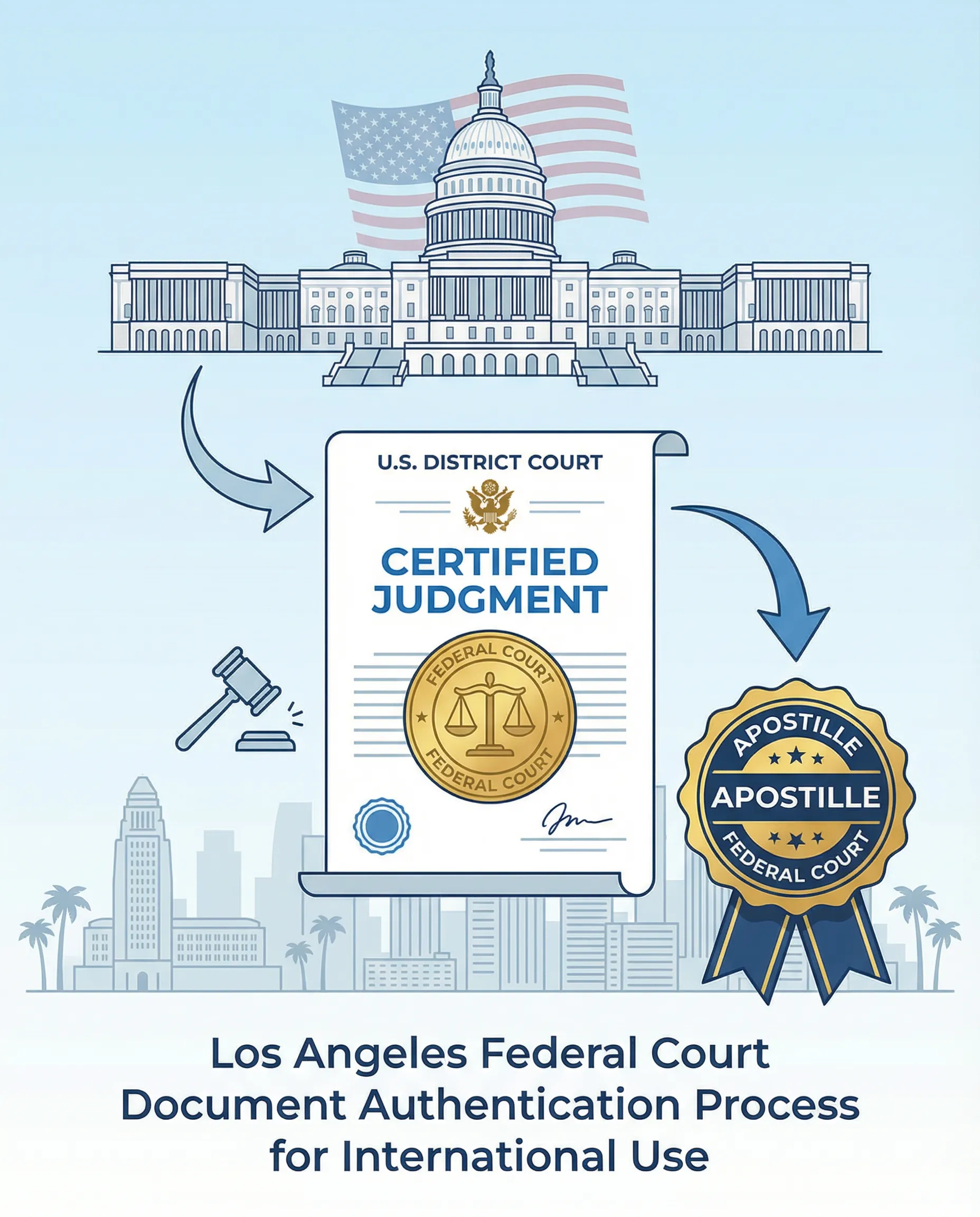
Apostille service for U.S. federal court judgments, orders, and certified records. We help Los Angeles clients get District Court and Court of Appeals documents authenticated and apostilled for use abroad. Serving all of California by mail.
Based in Los Angeles, coordinating federal court apostilles nationwide by mail. Rated 5.0 on Google based on 100+ reviews.
Make your U.S. federal court documents valid in another country
Foreign courts, government agencies, and lawyers often require certified copies of U.S. federal court judgments,
orders, and case records with apostille or authentication before they will rely on them.
Because these documents come from U.S. District Courts or Courts of Appeals, they usually need a special form of
federal certification before they can be apostilled or legalized. The goal is to create a chain of signatures
that foreign authorities can trust.
We help you request the right type of certified copy from the federal court clerk, confirm which federal
authority must authenticate it, and then coordinate apostille or authentication for your destination country.
Experience with U.S. federal court records and foreign use
Assist with apostilles and authentications for certified judgments, orders, bankruptcy records, and
other federal court documents used in foreign courts and proceedings.
Review your existing copies and court correspondence so you know whether you already have acceptable
certified records or must request new ones from the clerk.
Clarify when records must be certified by the clerk, when additional federal certifications are required,
and how those signatures are recognized for apostille or authentication.
Provide clear expectations on fees and timelines, which can be longer for federal matters, so you can
plan ahead for hearings, filings, or deadlines abroad.
We frequently work with law firms and self‑represented clients who receive instructions from foreign counsel or
courts to "obtain certified U.S. federal judgment with apostille" but are not sure how to navigate the federal
certification and apostille process. We turn that instruction into a practical checklist.
Simple 3–step process
How U.S. federal court apostille works
1. We review your case and the foreign requirements.
You can send copies of your federal court documents, the case caption, and any instructions from foreign
counsel or the court. We identify which documents need certified copies, whether they must bear a clerk's
seal, and which federal authentication path applies for your destination country.
2. We help you obtain properly certified federal court records.
If new certified copies are needed, we provide clear instructions for requesting them from the appropriate
U.S. District Court or Court of Appeals clerk, including what to ask for and how many originals to order.
We then verify that the signatures and seals on the records meet the standards required for federal
authentication and apostille.
3. We coordinate authentication, apostille, and return delivery.
Once your records are in the correct format, we submit them for the required federal authentication and
apostille or legalization, track processing, and return the completed documents to you or your law firm by
mail or courier. For non‑Hague countries, we can outline additional consular legalization steps after the
federal stage.
Federal court documents often involve multiple government offices and longer timelines than state records. We
set expectations up front and discuss any available rush options so you can coordinate with foreign counsel
and courts.
Common reasons for federal court apostille
When clients apostille U.S. federal court documents
Foreign litigation and enforcement of judgments
Parties seeking to recognize or enforce a U.S. federal judgment in another country are often asked to submit
certified copies of the judgment and related orders with apostille or authentication.
Cross‑border business and bankruptcy matters
Businesses involved in cross‑border insolvency, reorganization, or other federal proceedings may need
apostilled copies of bankruptcy orders, confirmations, or other case records for foreign courts and regulators.
Immigration and nationality cases
Certain immigration or nationality matters abroad may require proof of U.S. federal court decisions, especially
where status, name changes, or specific findings were issued by a federal judge. For USCIS documents, see our
naturalization apostille page.
Arbitration and settlement documentation
When arbitration awards or settlements are confirmed by a U.S. federal court, foreign authorities sometimes ask
for apostilled copies of the confirming order or judgment as part of their review.
Federal court apostille FAQ
Questions about apostilling U.S. federal court documents
Can I use the copies I downloaded from PACER?
PACER printouts are not usually sufficient for apostille or authentication. Most foreign authorities require
certified copies bearing the federal court clerk's seal and signature. We explain exactly what to order from
the clerk's office.
Do federal court documents go through state or federal apostille?
Because these documents originate from federal courts, they typically require a federal‑level authentication
and apostille process, not just a state apostille. We confirm the correct path for your specific records and
destination country.
Can I notarize federal court documents locally instead?
Having a local notary copy‑certify a federal court record usually will not meet foreign or federal requirements.
The safer approach is to obtain official certified copies from the court and proceed through the appropriate
federal authentication channel.
How many certified copies should I order?
Some clients need the same record for multiple foreign jurisdictions or agencies. We can help you decide how
many apostilled originals to plan for so you do not have to re‑start the process later.
How long does federal court apostille take?
Timing depends on how quickly the court issues certified copies and current processing times at the federal
authentication and apostille offices. We provide a realistic range and discuss rush options when available so
you can coordinate with foreign deadlines.
Start your federal court apostille
Serving Los Angeles in person and clients nationwide by mail
Share copies of your federal court documents and your destination country so we can confirm what is required and
outline a realistic apostille or authentication timeline before you commit to hearings or filing deadlines
overseas.
We regularly help law firms, businesses, and individuals prepare federal court records for use in Europe, Asia,
Latin America, and beyond. Mail‑in apostille options are available even if you are currently outside California.
When you reach out, it helps to include:
The name of the federal court, case number, and type of document you need apostilled.
Whether you already have certified copies from the clerk or still need to order them.
The country where the documents will be used and any court or filing deadlines you are facing.
Death Abroad Apostille Service | Mobile American Notary
Federal Document Services
Consular Report of Death Abroad Apostille Los Angeles
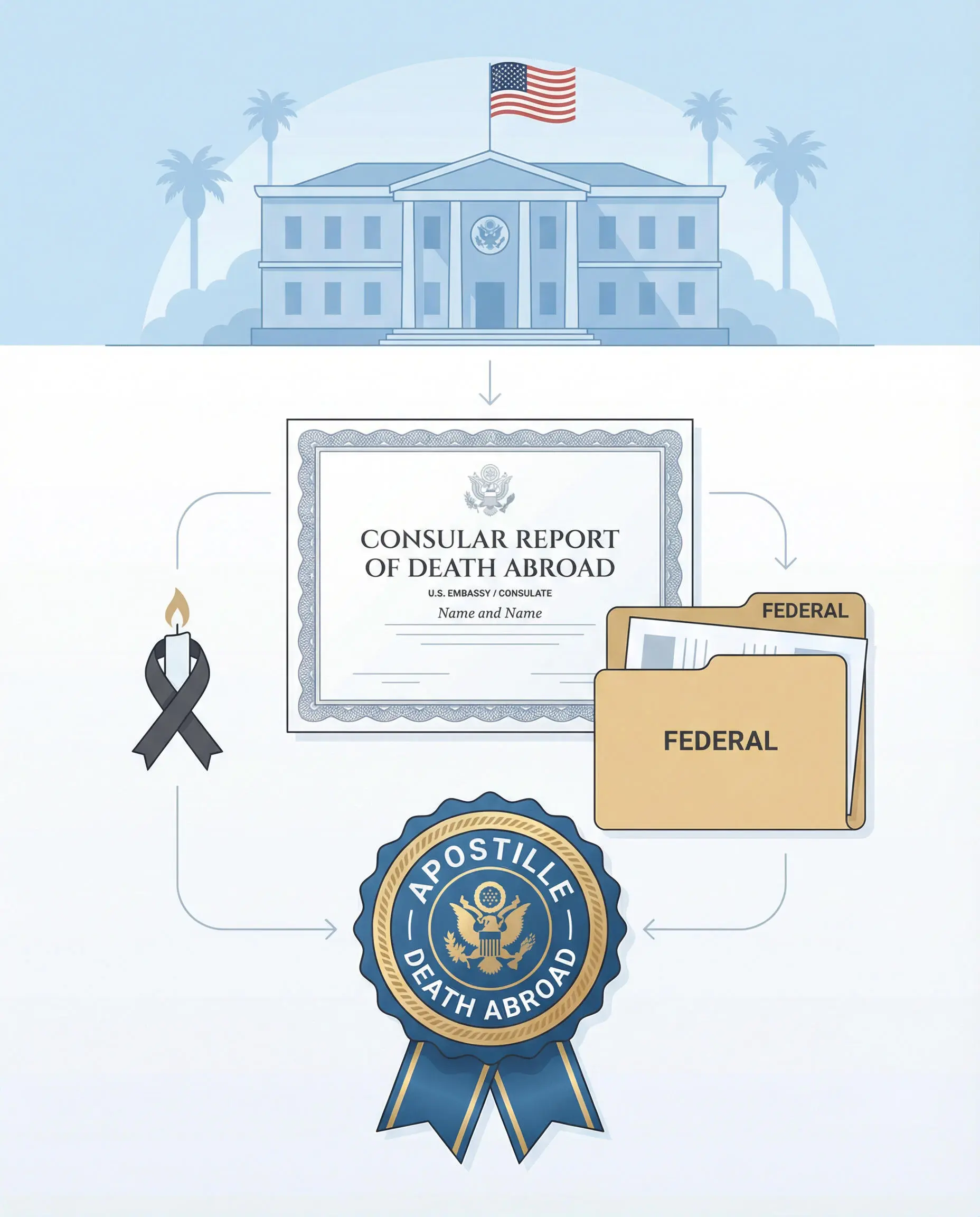
Apostille service for Consular Reports of Death Abroad and U.S. consular death certificates. We help families in Los Angeles and across California get these federal records apostilled for estates, insurance, and legal matters overseas. Serving all of California by mail.
Based in Los Angeles, coordinating consular death certificate apostilles nationwide by mail. Rated 5.0 on Google based on 100+ reviews.
Make a Consular Report of Death Abroad valid in another country
When a U.S. citizen passes away outside the United States, a U.S. embassy or consulate may issue a Consular Report
of Death Abroad or a similar consular death certificate summarizing local records and U.S. citizenship details.
Foreign courts, insurance companies, pension providers, and government agencies often require this consular death
record to be apostilled or authenticated before they will process estates, close accounts, or release benefits.
The apostille confirms that the document was genuinely issued or certified by the U.S. government and that the
signature and seal are valid.
We help you confirm whether your existing consular death report can be used, whether certified copies or
replacements must be requested from the U.S. Department of State, and how those documents must be submitted for
apostille or authentication for your destination country.
Experience with consular death records and estate needs
Assist with apostilles for Consular Reports of Death Abroad and related U.S. consular death certificates
used for estates, insurance, pensions, and property transfers in other countries.
Review scans of your consular death record and instructions from foreign lawyers, banks, or courts so you
know exactly which versions need apostille and how many originals to plan for.
Clarify how to request replacement or additional certified copies from the U.S. Department of State when
the original document is lost, damaged, or outdated.
Provide realistic timelines and fee ranges, and keep you updated while federal offices process
authentication and apostille so you can coordinate with foreign deadlines.
Families are often juggling grief, travel, and complex instructions from foreign institutions. We focus on making
the document side as straightforward as possible so you can move the estate or benefits process forward with fewer
surprises.
Simple 3–step process
How Consular Report of Death Abroad apostille works
1. We review your consular death record and destination requirements.
You can send a clear scan or photo of the Consular Report of Death Abroad or U.S. consular death
certificate, along with any instructions from foreign courts, banks, or attorneys. We confirm whether your
current document is eligible for apostille and whether additional certified copies should be requested.
2. We help you obtain the correct certified copies, if needed.
If you need replacements or more originals, we provide step‑by‑step instructions for requesting them from
the U.S. Department of State or other appropriate office, including information to include and how many
certified copies to order for your estate, insurance, or legal needs.
3. We coordinate federal authentication, apostille, and return delivery.
Once your consular death record is in the proper format, we route it through the appropriate federal
authentication and apostille or legalization process, track progress, and return the completed documents to
you or your attorney by mail or courier. For non‑Hague countries, we explain any additional consular
legalization steps after the federal stage.
Federal processing can take longer than state apostilles. We outline current timeframes and discuss options
early on so you can coordinate with court hearings, claim deadlines, and other time‑sensitive tasks.
Common reasons for a consular death apostille
When families apostille a Consular Report of Death Abroad
Probate and estate administration in another country
Foreign courts and notaries handling estates often require an apostilled consular death record before they will
open a file, appoint an executor, or allow property to be sold or transferred.
Life insurance and pension claims
Insurance companies and pension providers may ask for an apostilled Consular Report of Death Abroad to verify
death details and U.S. citizenship when processing claims and survivor benefits.
Bank accounts and investments abroad
Banks and financial institutions frequently require an apostilled death record before they will release funds,
close accounts, or transfer ownership of investment portfolios held overseas.
Government benefits and survivor programs
Some foreign government agencies and survivor benefit programs will only accept a consular death record once it
has been apostilled or authenticated, especially when benefits are paid to family members in multiple
countries.
Consular death apostille FAQ
Questions about apostilling a Consular Report of Death Abroad
Can I apostille a photocopy of the consular death record?
Photocopies are rarely accepted. Most foreign authorities require an original or certified copy issued by the
U.S. Department of State or consulate. We help you determine whether your document is suitable or if a new
certified copy should be ordered.
What if we never received a Consular Report of Death Abroad?
In many cases, families can request a copy or official record of the consular death report from the U.S.
Department of State. We provide guidance on how to submit that request and what information to include.
Does the consular death record need to be notarized?
Consular death records are federal documents and typically do not require notarization. Instead, they are
authenticated and apostilled through federal channels based on the embedded signatures and seals on the
certificate itself.
Is this different from a local foreign death certificate?
Yes. A Consular Report of Death Abroad summarizes information from local civil records and U.S. citizenship
documentation. Some foreign authorities only need the consular record; others may request both the local death
certificate and the consular report, sometimes each with an apostille.
What if the country where we are using the document is not part of the Hague Apostille Convention?
For non‑Hague countries, consular death records usually go through federal authentication followed by consular
legalization rather than a straight apostille. We can outline the steps for your specific country so you know
which certificates and stamps will be required.
Start your Consular Report of Death Abroad apostille
Serving Los Angeles in person and families worldwide by mail
Share a scan of your Consular Report of Death Abroad or consular death certificate and your destination country
so we can confirm what is required and outline a realistic federal apostille or legalization timeline before you
make estate or travel plans.
We regularly help families in Los Angeles, across California, and abroad prepare consular death records for use in
Europe, Asia, Latin America, and other regions. Mail‑in options are available even if you are currently outside
the United States.
When you reach out, it helps to include:
Whether you have the original consular death record or need a replacement or additional copies.
The country where the document will be used and whether it is for probate, insurance, banking, or another
purpose.
Any court, claim, or filing deadlines you are working with.
We will confirm fees, federal requirements, mailing or courier options, and the expected apostille or
legalization timeline before finalizing your appointment.
Completed 1 step
Here’s the updated federal-death-abroad.html with:
Phone text normalized to Call or Text (213) 933-2507.
CTAs flipped so booking is primary.
Booking buttons pointing to the dedicated Square service URL.
Copy‑paste ready:
xml
Death Abroad Apostille Service | Mobile American Notary
Federal Document Services
Consular Report of Death Abroad Apostille Los Angeles
Apostille service for Consular Reports of Death Abroad and U.S. consular death certificates. We help families in Los Angeles and across California get these federal records apostilled for estates, insurance, and legal matters overseas. Serving all of California by mail.
Based in Los Angeles, coordinating consular death certificate apostilles nationwide by mail. Rated 5.0 on Google based on 100+ reviews.
Make a Consular Report of Death Abroad valid in another country
When a U.S. citizen passes away outside the United States, a U.S. embassy or consulate may issue a Consular Report
of Death Abroad or a similar consular death certificate summarizing local records and U.S. citizenship details.
Foreign courts, insurance companies, pension providers, and government agencies often require this consular death
record to be apostilled or authenticated before they will process estates, close accounts, or release benefits.
The apostille confirms that the document was genuinely issued or certified by the U.S. government and that the
signature and seal are valid.
We help you confirm whether your existing consular death report can be used, whether certified copies or
replacements must be requested from the U.S. Department of State, and how those documents must be submitted for
apostille or authentication for your destination country.
Experience with consular death records and estate needs
Assist with apostilles for Consular Reports of Death Abroad and related U.S. consular death certificates
used for estates, insurance, pensions, and property transfers in other countries.
Review scans of your consular death record and instructions from foreign lawyers, banks, or courts so you
know exactly which versions need apostille and how many originals to plan for.
Clarify how to request replacement or additional certified copies from the U.S. Department of State when
the original document is lost, damaged, or outdated.
Provide realistic timelines and fee ranges, and keep you updated while federal offices process
authentication and apostille so you can coordinate with foreign deadlines.
Families are often juggling grief, travel, and complex instructions from foreign institutions. We focus on making
the document side as straightforward as possible so you can move the estate or benefits process forward with fewer
surprises.
Simple 3–step process
How Consular Report of Death Abroad apostille works
1. We review your consular death record and destination requirements.
You can send a clear scan or photo of the Consular Report of Death Abroad or U.S. consular death
certificate, along with any instructions from foreign courts, banks, or attorneys. We confirm whether your
current document is eligible for apostille and whether additional certified copies should be requested.
2. We help you obtain the correct certified copies, if needed.
If you need replacements or more originals, we provide step‑by‑step instructions for requesting them from
the U.S. Department of State or other appropriate office, including information to include and how many
certified copies to order for your estate, insurance, or legal needs.
3. We coordinate federal authentication, apostille, and return delivery.
Once your consular death record is in the proper format, we route it through the appropriate federal
authentication and apostille or legalization process, track progress, and return the completed documents to
you or your attorney by mail or courier. For non‑Hague countries, we explain any additional consular
legalization steps after the federal stage.
Federal processing can take longer than state apostilles. We outline current timeframes and discuss options
early on so you can coordinate with court hearings, claim deadlines, and other time‑sensitive tasks.
Common reasons for a consular death apostille
When families apostille a Consular Report of Death Abroad
Probate and estate administration in another country
Foreign courts and notaries handling estates often require an apostilled consular death record before they will
open a file, appoint an executor, or allow property to be sold or transferred.
Life insurance and pension claims
Insurance companies and pension providers may ask for an apostilled Consular Report of Death Abroad to verify
death details and U.S. citizenship when processing claims and survivor benefits.
Bank accounts and investments abroad
Banks and financial institutions frequently require an apostilled death record before they will release funds,
close accounts, or transfer ownership of investment portfolios held overseas.
Government benefits and survivor programs
Some foreign government agencies and survivor benefit programs will only accept a consular death record once it
has been apostilled or authenticated, especially when benefits are paid to family members in multiple
countries.
Consular death apostille FAQ
Questions about apostilling a Consular Report of Death Abroad
Can I apostille a photocopy of the consular death record?
Photocopies are rarely accepted. Most foreign authorities require an original or certified copy issued by the
U.S. Department of State or consulate. We help you determine whether your document is suitable or if a new
certified copy should be ordered.
What if we never received a Consular Report of Death Abroad?
In many cases, families can request a copy or official record of the consular death report from the U.S.
Department of State. We provide guidance on how to submit that request and what information to include.
Does the consular death record need to be notarized?
Consular death records are federal documents and typically do not require notarization. Instead, they are
authenticated and apostilled through federal channels based on the embedded signatures and seals on the
certificate itself.
Is this different from a local foreign death certificate?
Yes. A Consular Report of Death Abroad summarizes information from local civil records and U.S. citizenship
documentation. Some foreign authorities only need the consular record; others may request both the local death
certificate and the consular report, sometimes each with an apostille.
What if the country where we are using the document is not part of the Hague Apostille Convention?
For non‑Hague countries, consular death records usually go through federal authentication followed by consular
legalization rather than a straight apostille. We can outline the steps for your specific country so you know
which certificates and stamps will be required.
Start your Consular Report of Death Abroad apostille
Serving Los Angeles in person and families worldwide by mail
Share a scan of your Consular Report of Death Abroad or consular death certificate and your destination country
so we can confirm what is required and outline a realistic federal apostille or legalization timeline before you
make estate or travel plans.
We regularly help families in Los Angeles, across California, and abroad prepare consular death records for use in
Europe, Asia, Latin America, and other regions. Mail‑in options are available even if you are currently outside
the United States.
When you reach out, it helps to include:
Whether you have the original consular death record or need a replacement or additional copies.
The country where the document will be used and whether it is for probate, insurance, banking, or another
purpose.
Any court, claim, or filing deadlines you are working with.
We will confirm fees, federal requirements, mailing or courier options, and the expected apostille or
legalization timeline before finalizing your appointment.
Follow-ups
Add Square booking links for apostille services
Include California apostille fees $20 and $6 handling
Structure hero section for mobile notary LA
Add footer CTA with phone (213) 933-2507
Update sitemap and blog links for this page
No audio detected. Make sure your microphone is connected and unmuted