Travel Consent Forms for Minors — Notary, Apostille, and What Embassies Want
Traveling internationally with a minor — or sending one off with a grandparent, coach, or aunt? Some countries require a notarized parental consent. A few want it apostilled. Here's which countries, what to include, and how to time it.

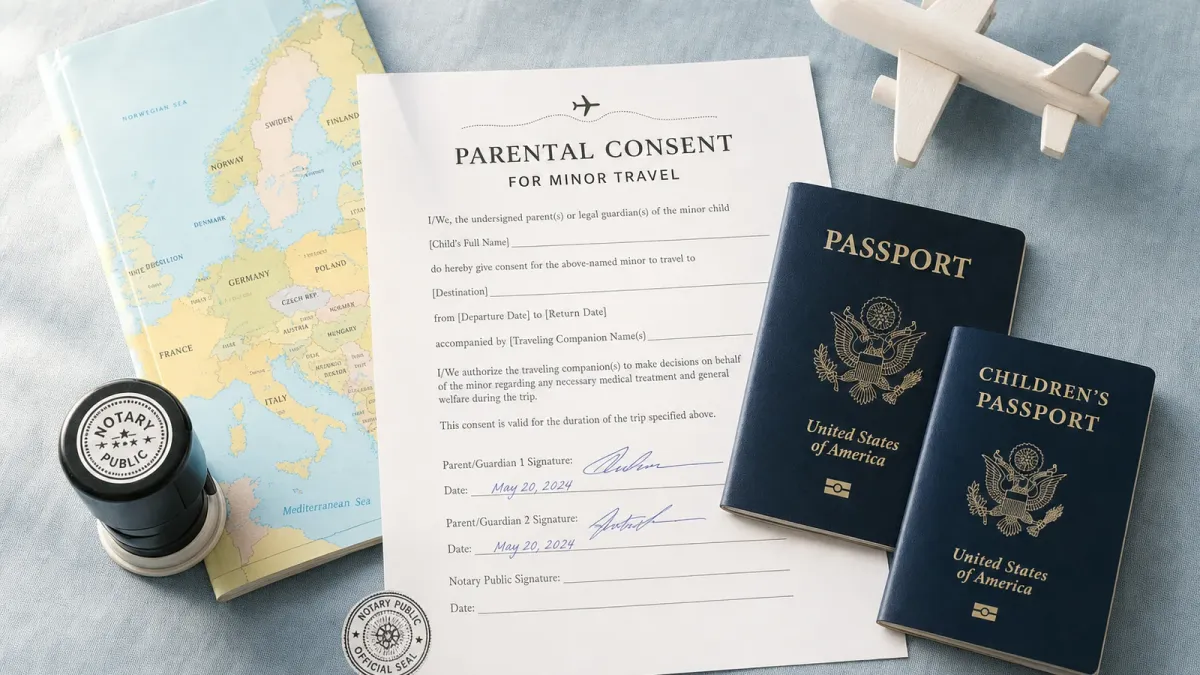
Short version: If one parent is traveling internationally with a minor (or the child is traveling with someone other than a parent — grandparents, a coach, an aunt), the destination country may require a notarized parental travel consent form. Some countries want it apostilled on top of that. The form itself is a one-page document, the notary is straightforward, but the apostille adds time. If you have a summer trip booked, don't wait until the week before. Call (213) 933‑2507 and we'll get it handled fast.
When do you actually need a travel consent form?
A travel consent form (sometimes called a "parental authorization letter," "child travel consent," or "permission to travel") is used in three common situations:
- One parent traveling internationally with the child, while the other parent stays home. Border agents in some countries will ask the traveling parent to prove the non-traveling parent consents.
- The child traveling with a non-parent — a grandparent, an aunt, a family friend, a youth sports team, a study-abroad program, a religious mission trip.
- A single parent traveling alone with the child, especially if the other parent is deceased, has sole custody waived, or is unknown. Even sole-custody parents sometimes need documentation to satisfy border agents at the destination.
The form is not legally required by the U.S. — there's no federal law that says you must have one to leave the country. But that's not the question. The question is whether the destination country, the airline, or a connecting country will let you through without it.
Which countries actually ask for this?
This changes from year to year and even agent to agent, but a current snapshot of countries where travel consent issues come up most often:
| Country / region | Notarized consent typically needed? | Apostille often required? |
|---|---|---|
| Mexico | Yes — Mexican law (SAM form) for minors entering or leaving Mexico | Sometimes (for residency, school enrollment) |
| Canada | Recommended, not always enforced | Usually not |
| UK, Ireland | Recommended for non-parent travel | Usually not |
| Schengen (EU) | Usually required for non-parent travel; some countries (Germany, Spain, Italy) ask for it from one-parent travel too | Often yes — especially Spain, Italy, Portugal |
| South Africa | Yes — strict requirements, certified copies of birth certificates required | Yes |
| Brazil | Yes — Brazilian law for foreign minors | Yes |
| Costa Rica, Panama | Yes — especially for residency or extended stays | Often yes |
| UAE, Saudi Arabia | Yes — strict | No apostille (these aren't Hague countries) — embassy legalization instead |
| Most Caribbean countries | Sometimes — varies by airline more than country | Usually not |
The reality is that border enforcement is inconsistent. We've had clients sail through Mexico City immigration with no document at all, and we've had clients turned around at Cancun because the agent that day wanted the SAM form. The cost of having a notarized consent in your folder is about $15-30. The cost of being denied boarding or sent home from the destination is the entire trip. Bring the form.
What needs to be on the consent form
There's no one-size-fits-all template, but most consulates and airlines look for the same elements:
- Full legal name and date of birth of the child
- Passport number of the child
- Full legal name of the non-traveling parent(s) giving consent
- Their relationship to the child (mother, father, legal guardian)
- Full legal name of the traveling adult (and their relationship to the child if not a parent)
- Travel dates — when the child is leaving the U.S. and when they are returning
- Destination country/countries
- Emergency contact information for the non-traveling parent
- Authorization for medical decisions — typically a line giving the traveling adult authority to consent to emergency medical care if needed
- Signature of the non-traveling parent(s) in front of a notary
If both parents are non-traveling, both should sign — and ideally both should sign in front of the notary together, though we can do two separate appointments if needed. If a parent is deceased, attach a copy of the death certificate. If one parent has sole legal custody, attach the court order.
Need a notarized consent before a trip? Call (213) 933‑2507 — we come to you, including evenings and weekends when needed.
When do you need the apostille (and when do you not)?
Adding an apostille to a notarized travel consent is a separate, optional step depending on the destination. As a general rule:
- Apostille required: if the consent is being submitted to a foreign government office (immigration, residency application, school enrollment, custody court) rather than just shown to a border agent
- Apostille not required: if the consent is only going to be shown at the border or to the airline at check-in. A notarized original is usually enough.
Specific destinations where we routinely apostille consents: Spain, Italy, Brazil, South Africa, Costa Rica, Panama, and Mexico when the trip is for residency or a school year rather than tourism.
The apostille step adds 1-2 weeks if done by mail to Sacramento, or can be done same-day at the LA or Sacramento Secretary of State office. Cost is $20 per document at the SoS, plus our service fee if we handle it.
Timing — summer travel is here, don't wait
Right now (June 2026), here's a realistic timeline for getting a travel consent ready:
- Notary only, no apostille — same day, often within a few hours of calling
- Notary + in-person apostille (LA office) — same day if we go that day, otherwise next business day
- Notary + mailed apostille — currently 1-2 weeks total based on Sacramento turnaround (processing requests received around June 9, 2026)
If your trip is more than three weeks out, the mail route saves money. If it's less than three weeks out and apostille is required, plan on in-person at the SoS office — and call us early in the week to get on the schedule.
Common mistakes that cost people trips
- Assuming the airline will accept an unnotarized "I give permission" letter — they sometimes do, but if your connecting country or destination wants notarization, you're done
- Notarizing without specific travel dates — some border agents reject open-ended consents. Put the dates on the form.
- Forgetting to apostille for residency/school applications — finding out at the foreign consulate that you need the apostille after the trip is the worst time to learn this
- Using a generic template that misses the destination country's specifics — Mexico's SAM form has its own format. South Africa wants certified birth certificate copies attached. Spain wants the parents' passport numbers. Look up the specific destination before drafting.
- One parent signing for both — if both parents have legal custody, both need to sign. Forging or guessing is not an option.
What we do — and what we don't
We notarize travel consent forms across LA County and we apostille them through the California Secretary of State. We come to you — home, office, the airport hotel the night before a flight. We've done plenty of last-minute consents at coffee shops, in airport lobbies, and in driveways.
We don't draft the form for you (we're notaries, not attorneys), but most parents either find a clean template online or use one provided by the destination country's consulate. If you're stuck, your destination country's consulate website is usually the most reliable source for what they want to see.
When to call us
If you have a trip in the next 30 days and a minor is traveling, get the consent handled this week. Call (213) 933‑2507. We'll come to you, get the signatures notarized, and if you need the apostille, we'll handle that next.