How a Mobile Notary Helps With Trust and Estate Planning in Los Angeles


How a Mobile Notary Helps With Trust and Estate Planning in Los Angeles
Planning your estate is one of those tasks that sits on the to‑do list for years—until a health scare, a real estate transaction, or a family change makes it urgent. In Los Angeles, traffic, work schedules, and health issues can make it hard to get everyone into a traditional office at the same time. That’s where a mobile notary focused on trust and estate documents can make the process much easier.
In this guide, you’ll learn which estate planning documents typically need a notary, how mobile notarization works in homes, law offices, hospitals, and care facilities, and what to expect if you are coordinating documents for a parent or loved one. For a broader overview of what a mobile notary can handle across Los Angeles County, you can also visit the main mobile notary services page.
Common estate planning documents that need a notary
Many core estate planning documents either require notarization or strongly benefit from having a notarized signature. In California, attorneys usually prepare the documents, and a mobile notary helps make sure they are executed correctly.
Typical documents include:
- Revocable living trusts – The main document that explains how assets should be managed during life and distributed after death.
- Powers of attorney – Financial powers of attorney that authorize a trusted person to handle banking, property, and other transactions.
- Advance healthcare directives – Documents that explain medical wishes and name someone to make health decisions if the signer cannot.
- Grant deeds and quitclaim deeds – Used to move real estate into a trust or between family members.
- Certification of trust / trust transfer deeds – Often requested by title companies and financial institutions when a trust holds property.
An attorney or document preparer should always tell you which documents need to be notarized and which need witnesses. The notary’s role is to verify identity, ensure the signer appears willing and aware, and complete the notarial certificates so the documents hold up later.
Why families and attorneys use a mobile notary for estate planning
Estate planning often involves multiple people: spouses, parents, adult children, and sometimes professional fiduciaries or trustees. Coordinating all of them at a single office can be difficult—especially when someone is in poor health or when family members live in different parts of Los Angeles County.
A mobile notary can help by:
- Coming to the signer – Home, office, senior living facility, or hospital room rather than a walk‑in location.
- Offering flexible scheduling – Evenings and weekends when family members are available.
- Coordinating with attorneys and advisors – Making sure documents are ready, printed, and in the correct signing order before the visit.
- Reducing stress for the signer – Particularly important for older adults or patients who tire easily.
For families specifically dealing with hospital situations, you can read more detail in the separate article on mobile notary for hospitals and care facilities in Los Angeles.
Estate planning signings at home
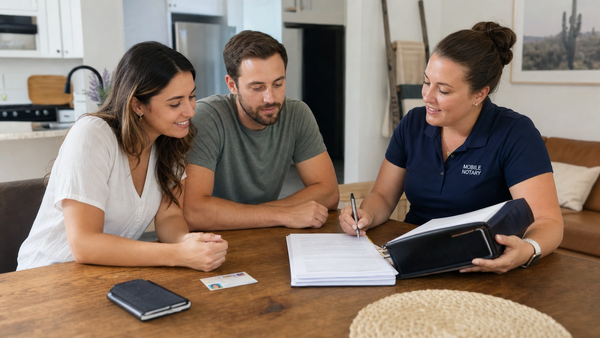
Most trust and estate signings in Los Angeles still happen at the dining table or kitchen island. For many families, home is the most comfortable place to review and sign important documents.
During a typical home estate planning appointment:
- The notary confirms the identities of all signers using acceptable ID.
- Everyone briefly reviews which documents will be signed and notarized.
- Documents are signed in the order your attorney prefers—trust, powers of attorney, health directives, then deeds or other forms.
- The notary completes acknowledgments and jurats, applies the seal, and double‑checks signatures and initials.
A good mobile notary will also build in time for questions about the signing process (not legal advice), and will slow down if anyone seems confused or overwhelmed.
Hospital and care‑facility estate planning signings
Sometimes the trust or power of attorney becomes urgent when a loved one is in the hospital, rehab, or a long‑term care facility. In those situations, a mobile notary who understands hospital notary procedures can help move quickly while still making sure the signing is valid.
Before a hospital or care‑facility visit, it’s important to:
- Confirm with the attorney that the documents are ready and complete.
- Make sure the signer has valid ID at the facility, or discuss options if ID is missing.
- Check that the signer is alert and able to explain what they are signing.
- Coordinate timing with the nurse’s station so the notary arrives when the patient is awake and visitors are allowed.
When trust or power‑of‑attorney documents are signed in a hospital, the notary will take extra time to speak directly with the patient, verify understanding, and note any unusual circumstances in the journal in case questions arise later.
Coordinating with attorneys and fiduciaries
Trust and estate planning is almost always guided by an attorney or professional document preparer. A good mobile notary works alongside that professional, not in place of them.
Behind the scenes, coordination typically includes:
- Confirming which pages need notarization and which need witnesses only.
- Checking whether any documents must be signed in a particular order.
- Verifying whether the attorney wants copies or scan‑backs immediately after the appointment.
- Discussing any special instructions, such as how to handle a signer who has limited mobility or uses a mark instead of a full signature.
When notaries and attorneys communicate clearly, families benefit from a smoother, faster signing with fewer surprises.
What clients should prepare before a trust or estate notary visit
To make the appointment smooth and avoid last‑minute surprises, families can prepare a few simple items in advance:
- Valid photo ID for every signer (driver license, state ID, passport, or other California‑approved ID).
- A complete set of documents from the attorney, printed single‑sided unless they say otherwise.
- The list of who will be present at the signing—spouses, adult children, witnesses, caregivers.
- Any special access instructions (gate codes, parking details, hospital room number).
- Payment method for the travel and notarization fees.
Having these details ready lets the notary focus on the actual signing instead of chasing logistics at the last minute.
When an apostille might be needed for estate documents
Most trust and estate planning is domestic, but some families have property or heirs outside the United States. In that case, you may eventually need an apostille for certain notarized documents so they will be accepted overseas.
Common examples include:
- Powers of attorney for property or bank accounts in another country.
- Affidavits or declarations requested by foreign courts.
- Estate documents used in a country that follows the Hague Apostille Convention.
If an apostille is needed, it is usually handled after the notarization, and often requires a separate courier trip to the county and state level. A notary who also handles apostille work can guide you through the steps so you don’t lose time. For more detail on avoiding problems in that process, see the article on common apostille mistakes.
How a mobile notary can support your estate planning
Trust and estate planning is about more than signatures and stamps—it’s about making sure the right people can step in when they’re needed most. A mobile notary who regularly handles trusts, wills, advance healthcare directives, and powers of attorney can take a lot of the pressure off during an already stressful time.
A well‑prepared Los Angeles mobile notary can:
- Travel to homes, offices, hospitals, and care facilities across Los Angeles, Orange, and Ventura Counties.
- Coordinate with your attorney or document preparer so everything is ready before the visit.
- Help families understand what IDs and logistics are needed so the signing goes smoothly the first time.
- Arrange follow‑up apostille service if any notarized documents will be used outside the United States.
If you are planning a trust signing, updating estate documents for a parent, or suddenly facing an urgent hospital or care‑facility situation, scheduling a mobile notary visit can be one of the simplest ways to keep the process moving forward. You can start on the mobile notary services page or visit the main Mobile American Notary & Apostilles homepage to explore other services like apostille work and jail notarization.