DS-3053 Notarization in California: What the Absent Parent Needs
When one parent cannot attend a child’s passport appointment, the absent parent may need to sign Form DS-3053 before a notary. Here is how California’s jurat, ID-copy requirement, and 90-day deadline fit the federal DS-11 process.

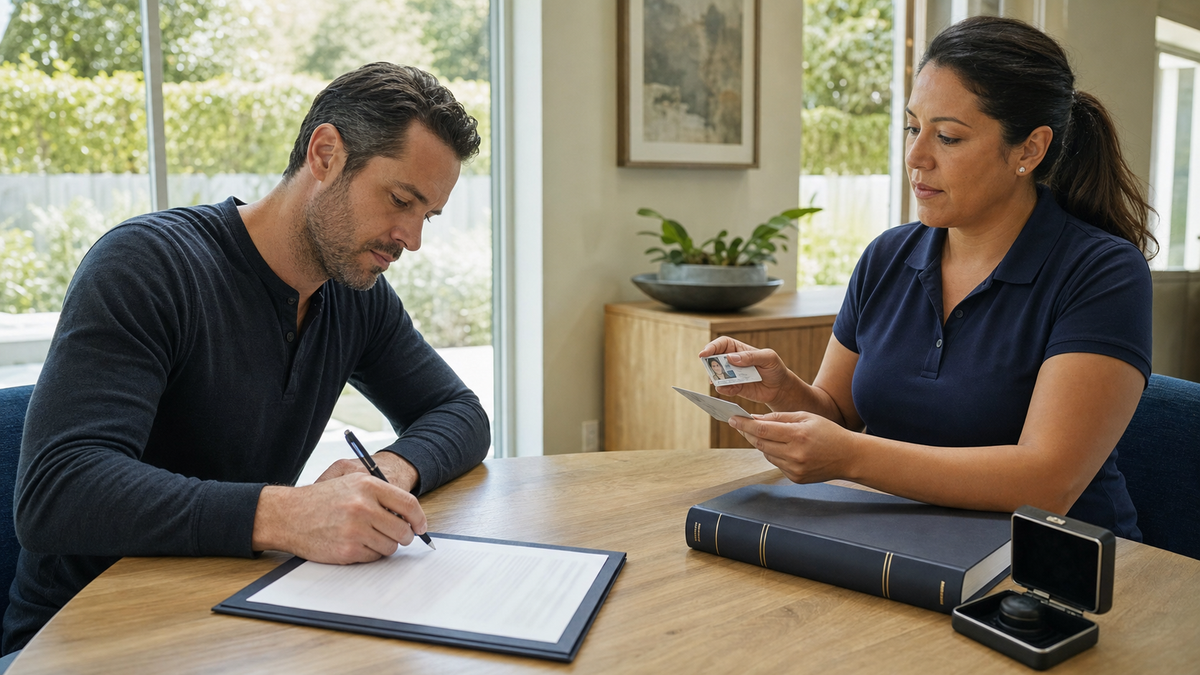
Short answer: When one parent cannot attend a child’s passport appointment, that absent parent may use Form DS-3053, Statement of Consent. The absent parent—not the child—completes the consent, shows valid government-issued photo identification, signs under oath in front of the notary, and provides a clear copy of the front and back of that same ID. The consent is valid for 90 days from the notary’s signed date.
DS-3053 is part of the federal passport process. It is not a general permission letter for a child to travel, and the notary does not decide whether the form is appropriate for a family’s circumstances.
Where DS-3053 fits into the DS-11 passport process
For a child under 16, both legal parents or guardians normally appear with the child at an authorized passport acceptance facility. The child applies on Form DS-11 and must appear in person. A child’s passport cannot be renewed by mail; a new in-person application is required each time, and a passport issued before age 16 is valid for five years.
If one parent or guardian cannot appear, the non-applying parent can generally give consent on DS-3053. The parent attending the appointment brings the completed consent with the child’s DS-11 materials. The State Department’s child-passport instructions provide the current document checklist and should be checked before the appointment.
DS-3053 also lets both parents authorize a third party, such as a grandparent, to apply with the child. In that situation, the State Department generally requires consent from both parents or guardians and copies of both IDs. If only one parent gives that permission, the applying party must also provide evidence that the consenting parent has sole authority.
Who signs the form—and when
The signer is the non-applying legal parent or legal guardian, called the “affiant” on the form. The child does not sign the DS-3053 consent, and the parent who will attend the passport appointment does not sign for the absent parent.
The absent parent may fill in Sections 1 through 3 before meeting the notary, but should stop at Section 4. The current form says to wait to sign until the passport authorizing officer or notary asks. The parent’s signature date and the notary’s date must match.
Before signing, review the entries carefully. The current DS-3053 says to type or print legibly in black ink. If there is an error, it instructs the signer to complete a new form rather than correct the existing one. The notary identifies the signer and performs the notarial act; the notary does not choose the answers, prepare the consent, or evaluate the family’s legal rights.
Why California treats DS-3053 as a jurat
Section 4 contains an oath or affirmation that the information is true and correct to the signer’s knowledge and belief. That makes the California notarial act a jurat, not an acknowledgment.
Under California Government Code section 8202, a jurat requires the notary to:
- Have the parent personally appear.
- Identify the parent using satisfactory evidence.
- Administer an oath or affirmation.
- Watch the parent sign the document.
- Complete the California jurat certificate.
California’s certificate must include the statutory “subscribed and sworn to (or affirmed)” wording and a boxed notice explaining that the notary verifies the signer’s identity, not the truthfulness, accuracy, or validity of the document. Because the federal form’s printed notary area does not contain the complete California jurat wording and notice, expect the notary to attach a separate California-compliant jurat certificate. Keep that certificate attached to the DS-3053.
This is one reason not to sign early. Unlike an acknowledgment, a jurat requires the signature to be made in the notary’s presence after the oath or affirmation.
The ID and photocopy are two separate requirements
The parent must present valid government-issued photo ID to the notary. The form lists a driver’s license, passport, military ID, or another qualifying ID and asks the notary to record identifying details.
The parent must also attach a clear photocopy of the front and back of the same ID shown to the notary. Bringing an ID to the appointment is not enough by itself. A copy of a different ID can create a mismatch with the identifying document entered on the form.
A simple appointment checklist is:
- Current, uncorrected DS-3053 with Sections 1–3 completed
- The valid government-issued photo ID the parent will present
- A clear front-and-back photocopy of that exact ID
- The child’s name and birthdate exactly as shown on Form DS-11
- The applying adult’s full name and relationship to the child
A California notary must independently determine whether the identification presented satisfies state law. If there is a question about a particular ID, ask before the appointment rather than substituting another document at signing.
Start the 90-day clock on the notarization date
The DS-3053 consent is valid for 90 days from the passport authorizing officer’s or notary’s signed date. If the child’s passport application is not submitted before the consent expires, the State Department form says new consent is required.
Plan backward from the child’s in-person appointment. Avoid notarizing months early, and leave time to send the signed form and attached ID copy to the parent or adult who will attend. The DS-3053 accompanies the DS-11 application; it is not mailed by the absent parent as a separate passport application.
When DS-3053 may not be the document used
The State Department lists other routes for specific situations. These are federal document requirements, not custody advice:
- Evidence of sole authority: Consent may not be required when the applying parent submits qualifying evidence, such as a death certificate for the other parent, a court order granting sole legal custody or sole permission to apply, or a birth certificate listing only one parent.
- The other parent cannot be found: The State Department may consider Form DS-5525, which asks for a detailed statement of special family circumstances. Approval is not automatic.
- A third party applies: Both parents may use DS-3053 to authorize that person. The application package generally includes both parents’ ID copies.
- The absent parent is deployed: State Department guidance says a deployed parent should provide a notarized DS-3053 in most cases. Military families should review the agency’s current alternatives if that is not possible.
- The signer is outside the United States: In certain countries, DS-3053 must be notarized at a U.S. embassy or consulate and cannot be notarized by a local notary. Check the current country list before arranging the appointment.
For applicants ages 16 or 17, the rule is different: the State Department requires evidence that one parent or guardian is aware of the application and may request DS-3053 in some cases. Use the agency’s separate instructions for that age group rather than assuming the under-16 process applies.
DS-3053 is not a minor travel-consent letter
DS-3053 authorizes passport issuance. A minor travel-consent letter addresses permission for a child to travel with one parent or another adult. Airlines, border authorities, or a destination country may have their own travel-document expectations, so one form should not be treated as a substitute for the other.
Likewise, notarization does not settle custody questions or guarantee that a passport agency will accept an application. The notary verifies identity, administers the oath, witnesses the signature, and completes the jurat. Questions about which consent or authority documents apply belong with the State Department or a qualified attorney.
Need the absent parent’s signature notarized in California? Review the form and ID-copy checklist first, then schedule a mobile DS-3053 notarization at a convenient location.