Apostille for Mexico — What's Actually Required in 2026
Mexico accepts apostilles. If your document was issued in California, you need a California apostille — not a Mexican one. Here's exactly how, what it costs, and how long it actually takes in 2026.

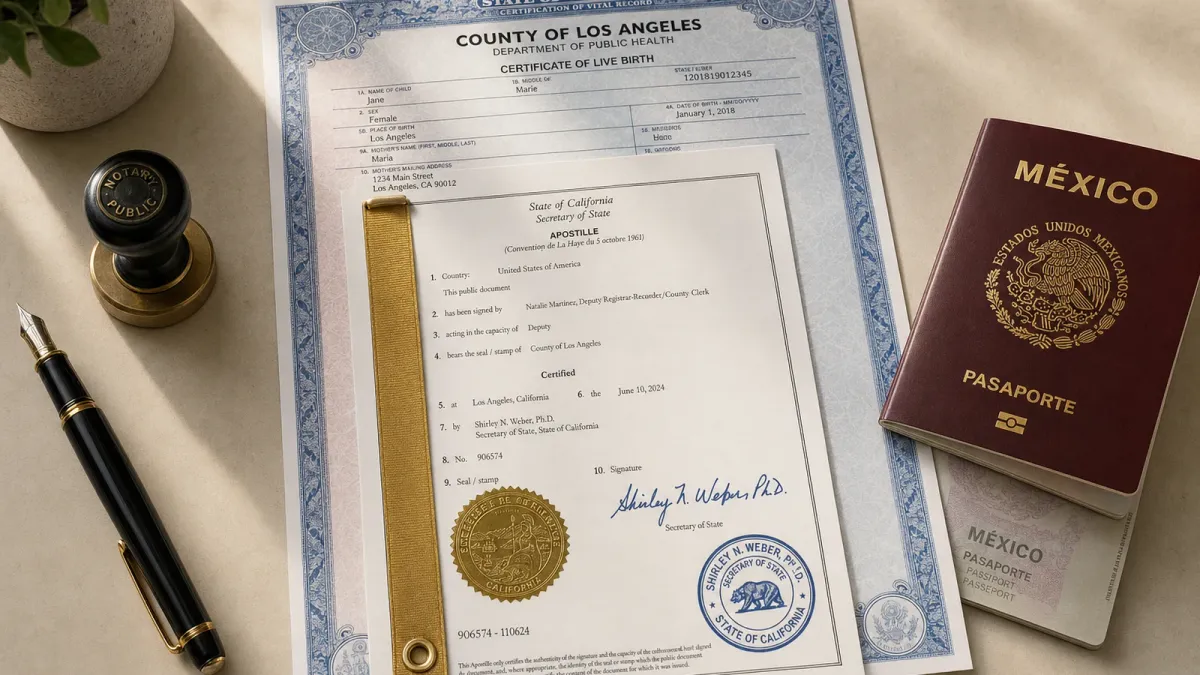
Short version: Mexico accepts apostilles. If your document was issued in California, you need a California apostille — not a Mexican one. Sacramento mail is currently around 1-2 weeks. In-person at the LA or Sacramento Secretary of State office is same-day. Cost is $20 per document, plus $6 for each unique notary signature. If you'd rather skip the trip downtown, call (213) 933‑2507.
Does Mexico accept apostilles?
Yes. Mexico has been part of the Hague Apostille Convention since August 14, 1995 — so this is old, settled territory. Any document going from the United States to Mexico just needs an apostille (pronounced "uh-poh-STEEL") from the issuing state. No consulate stamp. No embassy authentication. No red ribbon from the Mexican Consulate.
That's worth noting because the Mexican Consulate in Los Angeles does not apostille documents for you. We get calls every month from people who waited in line there for hours, only to be told the consulate doesn't handle it. The Secretary of State does — and that's where your California document needs to go.
Which documents need an apostille for Mexico?
The short answer: anything official that was created in California, when Mexico needs proof that it's real. The most common ones we see:
- Marriage certificates — for spousal visas, residency applications, name changes, divorce filings in Mexico
- Birth certificates — for Mexican passport applications (especially for children born in the U.S. to Mexican parents), school enrollment, dual citizenship
- Death certificates — for estate matters, property transfers, insurance claims, repatriation of remains
- Divorce decrees — for remarriage in Mexico, name changes, recognition of foreign divorce
- Power of Attorney — by far the most common one we handle for Mexico. Property sales in Mexico, bank account access, family matters, INM (immigration) filings
- FBI background checks — for residency applications (Temporal and Permanente visas)
- Single status affidavits — for marriage in Mexico (Mexico requires proof you're not already married elsewhere)
- Diplomas and transcripts — for work permits, professional licensure, employment verification
Translation note: Mexico requires most documents to be translated into Spanish by a perito traductor — a translator certified by the Mexican government or the receiving institution. We don't do those translations, and you generally want them done after the apostille is attached (so the translation includes the apostille text). Don't translate first, apostille second — you'll usually have to redo the translation.
How the process works in California
Step 1: Get the right version of your document
This is the step that trips people up most often. You need an official certified copy from the issuing agency — not a photocopy, not a notarized photocopy, not the PDF the hospital emailed you.
- Birth/death/marriage: certified copy from the county recorder or California Department of Public Health
- Divorce decree: certified copy from the issuing court (not your attorney's copy)
- Power of Attorney: needs to be signed in front of a notary first — then the notary's signature gets apostilled
- FBI background check: these are federal documents, not state — they go through the U.S. Department of State in Washington D.C., not California. Different process, longer timeline (usually 2-3 weeks via service, 6-8 weeks on your own)
Step 2: Submit for apostille
| Method | Turnaround | Cost | Best for |
|---|---|---|---|
| Mail to Sacramento | 1-2 weeks typical (currently processing requests received around June 9, 2026) | $20 per apostille + $6 per unique notary signature | Non-urgent, planning weeks ahead |
| In person — LA office | Same day, typically 30 minutes | $20 per apostille + $6 per unique notary signature | Urgent, deadline-driven |
| In person — Sacramento office | Same day, typically 30 minutes | $20 per apostille + $6 per unique notary signature | If you happen to be in Sacramento |
For mail, send to: Secretary of State, Notary Public Section, P.O. Box 942877, Sacramento, CA 94277-0001. Include a cover letter listing the destination country (Mexico), a check or money order for the fees, and a prepaid return envelope.
For in person in LA: the office is at 300 South Spring Street, Los Angeles, CA 90013. Open Monday-Friday, 8:00 a.m. to 5:00 p.m. Arrive by 4:30 p.m. to guarantee same-day service. As of mid-June 2026, the LA office is temporarily operating from Suite 1215 on the 1st floor due to an elevator outage — call ahead to confirm.
Rather not deal with it? If the trip to downtown LA, the certified copies, and the paperwork sound like more than you want to take on — that's what we're here for. Call (213) 933‑2507 and we'll handle it for you.
Power of Attorney for Mexico — the most common job
About half the apostilles we do for Mexico are Powers of Attorney. Someone in California needs to authorize a sibling, cousin, or attorney in Mexico to handle something — sell a house in Jalisco, manage a bank account, file paperwork with INM, sign for a probate matter.
Here's the order of operations that works:
- Draft the POA in Spanish (or bilingual). The receiving party in Mexico — the bank, the notary, the property registry — will want it in Spanish anyway. A bilingual draft saves a translation step.
- Sign in front of a California notary. Both parties physically present, valid ID, the works. The notary's California commission is what gets apostilled.
- Get the apostille. Either by mail or in person, as above.
- Send to Mexico. FedEx or DHL — Mexico's customs occasionally holds documents through standard mail, and the receiving party usually wants a tracking number anyway.
One thing to watch: some Mexican notaries (notarios públicos) want very specific language in the POA — particularly for property sales. If you're working with a specific notario in Mexico, ask them for their preferred template before you draft. Saves a redo.
Divorce decrees and single status affidavits
If you're getting married in Mexico and you were previously married:
- If divorced in California: you need a certified copy of the divorce decree from the issuing court, with the court clerk's stamp and signature. That's what gets apostilled — not the photocopy, not the version your attorney emailed you.
- If never married (or marriage ended long ago and you don't have the records): Mexico typically wants a single status affidavit. That's a sworn statement from you, notarized in California, declaring you're free to marry. We can prepare and notarize that on a mobile visit — then it gets apostilled like anything else.
Mexican civil registries (the Registro Civil) are strict about these. The original certified divorce decree with apostille, plus a Spanish translation by a perito traductor, is the standard package.
Common Mexico apostille mistakes
From eight years of handling these, here are the patterns we see go wrong:
- Translating before apostilling. The apostille has its own French/English text. If the translation doesn't include the apostille text, you'll get rejected at the Mexican consulate or civil registry. Apostille first, translate after.
- Photocopies instead of certified copies. A notarized photocopy of your birth certificate is not the same as a certified copy from the county recorder. The Secretary of State will reject the photocopy.
- Going to the Mexican Consulate first. The consulate doesn't apostille. It can do other things (consular IDs, passport services), but apostilles are the Secretary of State's job — and only the issuing state's SoS.
- Assuming a federal apostille covers state documents. Birth certificates are state-issued, so they need state apostilles. The federal apostille (from D.C.) is only for federal documents — FBI background checks, IRS letters, naturalization certificates, etc.
- Old divorce decrees. If your divorce was in 1995 and the court is now telling you they don't have the original on file, you may need to request a "court order vacating" or a certified case docket — and then have that apostilled. Adds time. Plan early.
Need this handled? Call (213) 933‑2507.
What we don't do
We handle U.S. documents going outside the U.S. That's the entire service. We don't have offices or partners in Mexico, so we can't help with documents originating in Mexico — even when those documents are coming back to California. For Mexican-origin documents (Mexican birth certificates, Mexican marriage certificates, Mexican court orders) headed to U.S. use, you'd need to work with the Mexican Secretaría de Relaciones Exteriores or an apostille service based in Mexico.
We also don't do translations. We can recommend translators in LA who specialize in Mexican legal Spanish, but we don't translate documents in-house. Apostille first, then translate.
When to call us
Most Mexico apostille jobs we do fall into one of these buckets:
- "My family in Mexico needs a POA signed by Thursday." — We come to you, notarize, run the apostille same-day at the LA office, hand it back the next day. Standard turnaround on this is 48-72 hours start to finish.
- "I'm getting married in Cabo and they want my divorce decree." — Order certified copy from the court (we can advise on this), apostille, then translate. Plan 2-3 weeks total.
- "My uncle passed away in Guadalajara and we need a death certificate apostilled for the property." — Get certified copy from California Department of Public Health, apostille, ship by FedEx with tracking. 5-7 days total.
- "I need to apply for Mexican residency and they want my FBI background check apostilled." — Federal job, not state. We can refer you to a federal apostille service that hand-delivers in D.C. Faster than mailing it yourself.
When you're ready to start, call (213) 933‑2507 — or send a message through the contact form and we'll get back to you the same business day.